CY TWOMBLY
&
TRACEY EMIN
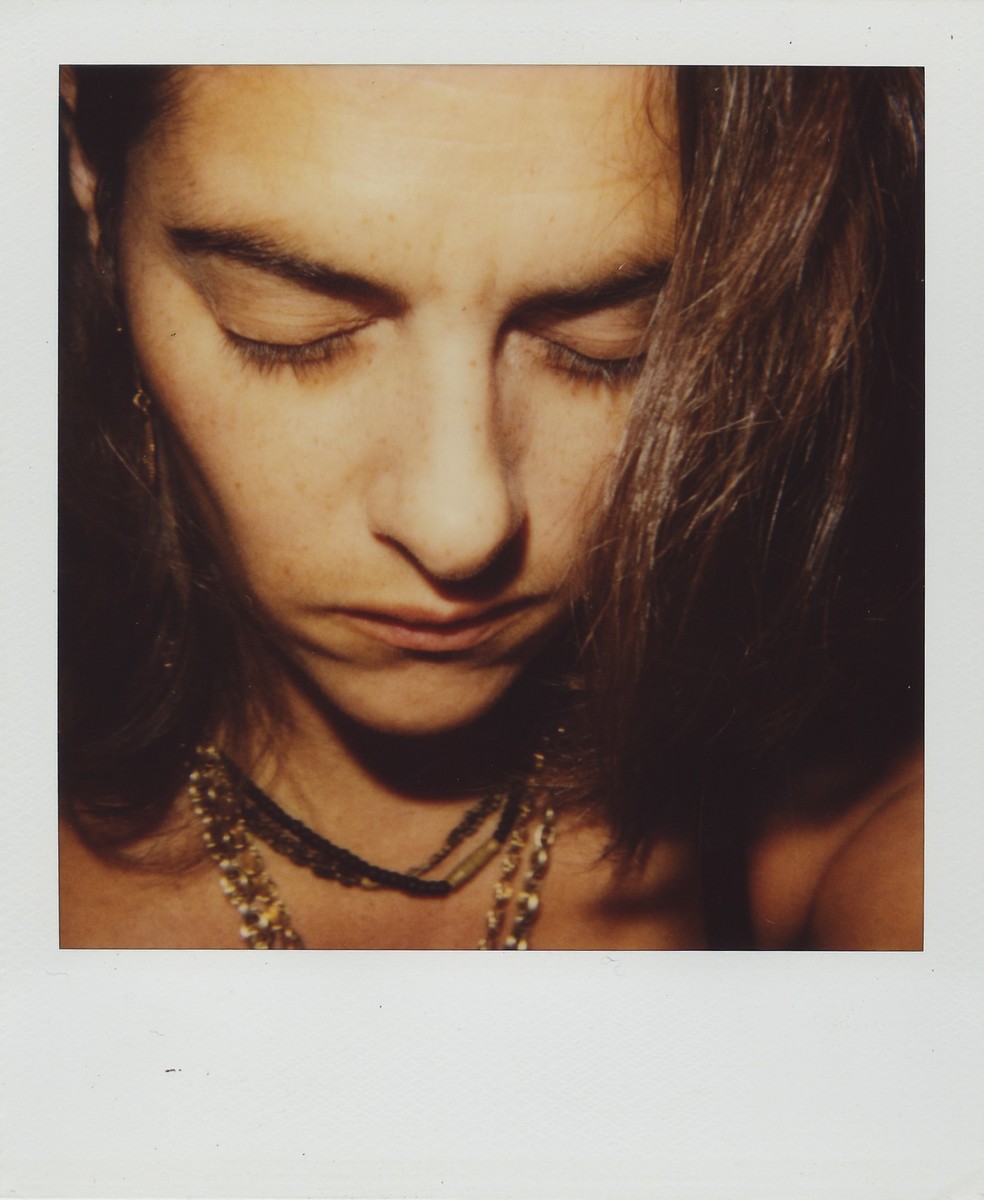
Tracey Emin, Self Portrait 12-11-01 (58/80), 2001
Polaroid
4.21 x 3.46 in.
© Tracey Emin
Courtesy of Tracey Emin Studio
The second season of In Perspective concludes with a special episode featuring Dame Tracey Emin. While we imagine ourselves immersed in the luminous glow of a Turner’s painting and the sea lapping at the shores of Margate, the artist – interviewed for this occasion by the art historian Adele Minardi – takes us on a journey of discovery through the place where she was born, where she has established her studio, and where she has carried out countless community projects, including TEARS, Tracey Emin Artist Residency. Her memories of the first encounter with Cy Twombly’s work intertwine with the deeply personal and autobiographical nature of her own pieces, and with the use of text and camera, elements that both artists incorporate into their work, following directions that are subtly complementary yet distinct. These form part of a larger project, her third life. “Everything I will be doing is getting ready to leave everything behind.”
PAINTING OVER IT
Tracey Emin on Cy Twombly, light, text, and her third life
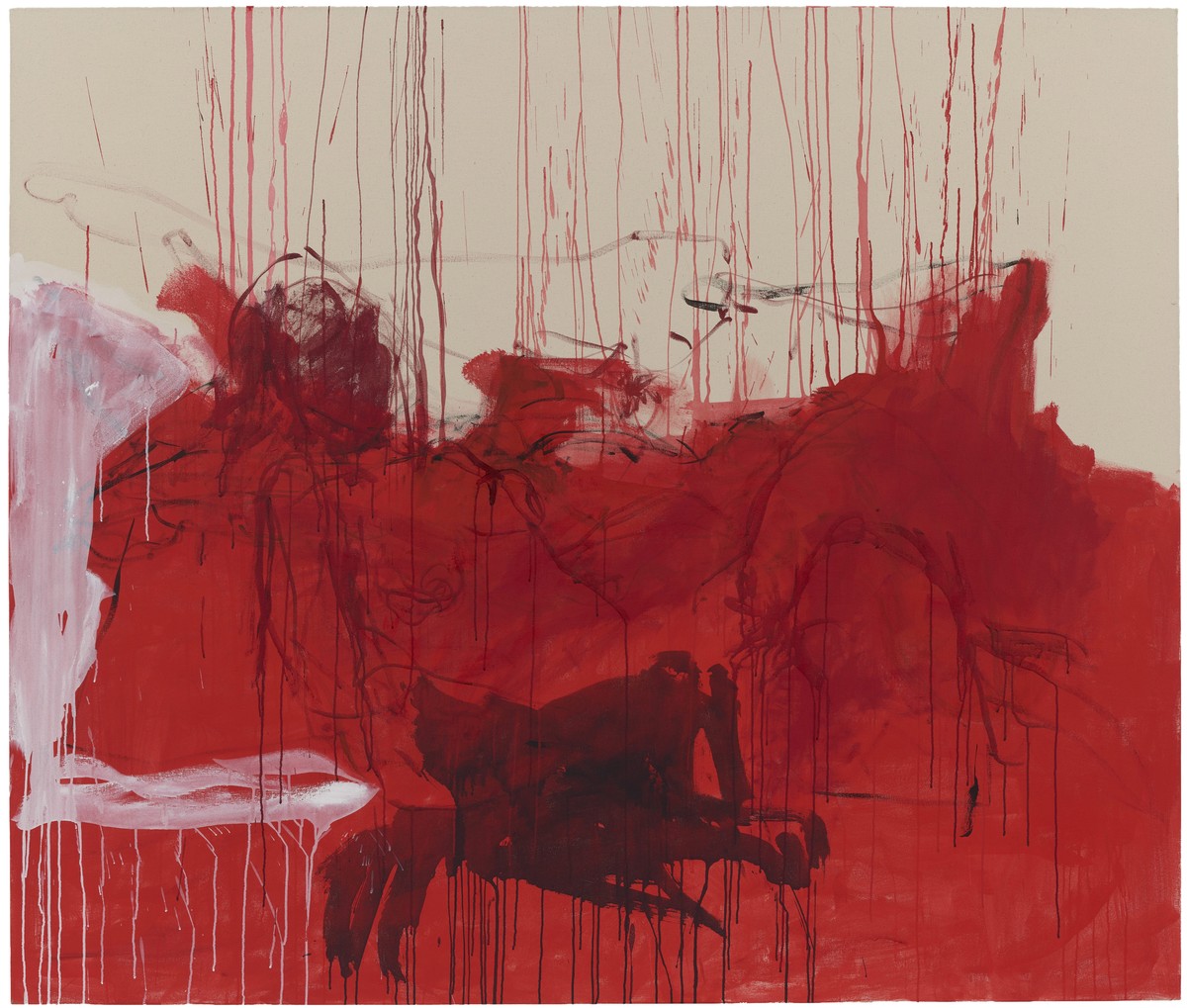
Tracey Emin, I never Asked to Fall in Love - You made me Feel like This, 2018
Acrylic on canvas
71.97 x 84.57 x 1.57 in.
© Tracey Emin
Courtesy of Tracey Emin Studio
AM (Adele Minardi)–Hi Tracey, it is very exciting to have the opportunity to chat with you on this beautiful occasion.
Around the time that this conversation was confirmed with your team, I was away, on a very remote island in the Mediterranean, closer to Tunisia than Italy. Here, there was a beautiful full moon and, looking at the moon, I thought about Cy Twombly’s Bolsena paintings that he made in the summer of 1969 in the aftermath of the Apollo 11 mission. Then, I also thought about something that I think Harry [Harry Weller - Creative Director of Tracey Emin Studio] mentioned in his text for the catalogue of A Second Life, your exhibition at Tate Modern. He said that you work in the studio with a particular energy during the full moon, and so I thought, “Okay, I can take the moon as a good, hopefully propitious sign!”
How are you and where are you right now?
TE (Tracey Emin) – Well, right now I'm in bed and my cat is next to me, one of them — Teacup — and it's midday. I'm in Margate by the sea — where my studio is — and most days I stay in bed or lie down until midday.
I like to be very quiet in the morning and I like to have my time to myself. So that's where I am. It's very calm, the sun comes in the afternoon in my bedroom. The light is very soft. Everything is very gentle.
AM – I was lucky to visit Margate too. Margate is where you grew up and it's where you have chosen to return, make your life and your work there. Living by the sea and being always exposed to, as you just mentioned, that particular light and that horizon offered by the sea.
TE – It goes back to a side thing because Turner was here. Turner painted the most amazing sunsets and seas here, and there is definitely a connection between Turner and Cy Twombly. It is just one hundred per cent the brush mark, the pink haze, the light, the nature, the aspect of the nature, the yellow, you can see these different colours, and I love that about Margate.
AM – Nature has an impact on anything and, of course, on you. What about the sea? What does the sea give you in all of this? Do you have a special connection with it?
TE – Yes. Where I swim, I wait for the tide to come in, and there's a great big wall, like a harbour arm, it looks like a Venetian harbour. When the tide comes in, I swim around the outside of the wall of the harbour and then it's like swimming in a De Chirico painting.
And every time it's totally surreal because there's no land, there's just the sea and it's really strange. Sometimes the colours of the sky are really strange as well. It's a totally unreal feeling! So, that's literally what I do in the sea, but the sea gives me a sense of escape because of the horizon. In Margate, we have a strange horizon because even though we're in the southeast, we face west, so that means the sun looks very close to us; the sun comes down in this great big half shape, then goes into the water and just slips away and it's really fantastic and magical. That is probably one of the most beautiful things about where I live.
AM – That's amazing. Speaking about Margate, you have done so much for the local community and in general for the art world, at the same time, you are deliberately away from London. Can you share more about it?
TE – Well, in Margate we're closer to France than we are to London, we're closer to Europe than we are to London. When I grew up here, it was like France was just across the water, Belgium was just across the water, we used to watch the ships going to these different places.
I had this idea that maybe the epicentre isn't the centre, maybe the epicentre is wherever you want it to be, and I thought, “Why can't Margate be the centre of the art world? Why can't Margate be like that?”
I had this idea, years ago, when I was turning on these lights at Dreamland, these big neon lights, and I gave this little speech that Margate could be the epicentre of the art world.
Now, Margate is a destination for people who love art, it is incredible! We have got Turner Contemporary, but we also have so many creative people living here.
Margate is on the Isle of Thanet, and the island used to — apparently — have mystical and transcendental ley lines and all this kind of stuff, so it seems like the perfect place for artists and creative people to be. For example, we have amazing shooting stars. When there were the northern lights, we could see them really clearly here, even though we're in the southeast of England. We could see them so clearly because we have a clear line up to the north from the channel, there is a magic about this place. That is what I think people feel when they come, it is sort of special, it's good!
AM – Absolutely. Especially for the young generation of artists, everything you are doing for them is really special, and really the opportunity that you give back to the community is extraordinary. Tracey, going back to your work, I would like to talk about your youth...
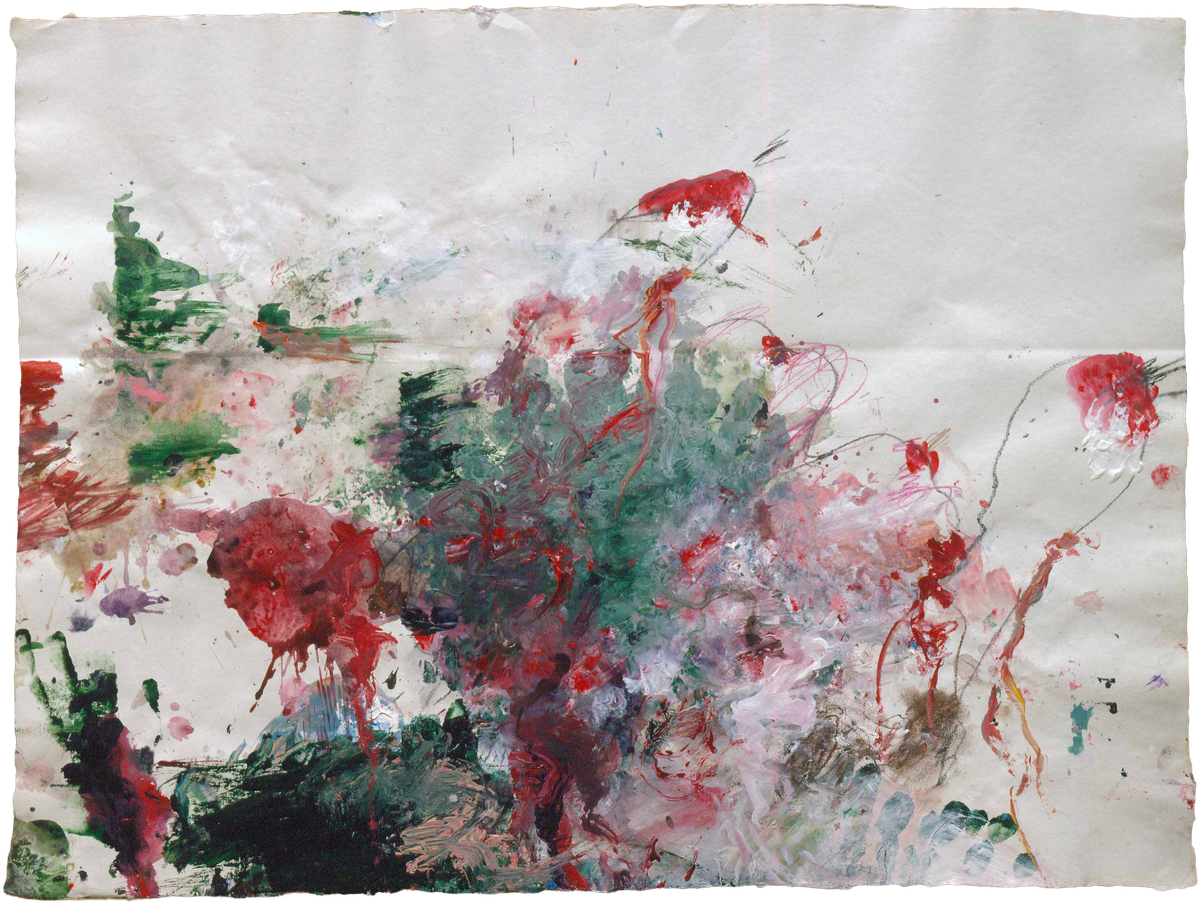
Cy Twombly, Scenes from an Ideal Marriage, 1986
[Porto Ercole]
Acrylic, pencil, wax crayon
21 174 x 28 3/4 in.
© Cy Twombly Foundation
TE – Yes, but don’t you want to know how I first came across Cy's work?
AM – Please!
TE – I really like this story! When I was at the Royal College of Art I had a tutor and in the first tutorial he had with me, he said, “I don't want that your work changes too much here, I'd be disappointed because you are very unique, and I want you to go to the Tate Gallery — this is where Tate Britain is now and it was just Tate — and there is an artist there, called Cy Twombly, and I want you to look at their work and I want you to see what similarities you have with that artist and tell me what you think.”
So, I went to the Tate and I looked at the work. There was writing in the work, drips, and it was pink and white. It was soft and beautiful, and not such a big painting, maybe one metre by one metre. It wasn't big.
The next week, I had my tutorial with him, and he said, “You didn't go to the Tate and see the painting, did you?
“Yes, I did,” I said.
“Oh, what did you think?” he said.
“I thought her work was beautiful.”
So, he said, “I told you to look at Cy Twombly!”
“Yes, I did. I thought it was really beautiful, she paints really beautifully!”
So, he goes, “But Cy Twombly is a man!”
“No, he's a woman!”
I had never heard of the name “Cy” before, and I just went and one hundred per cent thought a woman had made that painting. This was in 1987.
I think there was no way a man made that painting, it was too sensitive, it was too beautiful, it was too emotional.
AM – Thinking about your work and Cy's: he used to draw on the classics — ancient myths and stories — to access universal feelings: grief, loss, tragedy. He took those stories and made them his own, very personal. You do the opposite: you start from the intimate, the autobiographical, and move toward the universal. I find that fascinating — you're speaking the same language, just from opposite directions.
TE – Yes! One's clockwise and one's anti-clockwise, but we both end up at the same point.
When I was painting in France, maybe seven or eight years ago, I made a painting and I wrote “Rome” on it. And then I went, “Oh my God!”
I took a photo of it and sent it to Lorcan O'Neill.
I said to Lorcan, “Look! I just painted a Cy Twombly painting. Look at this, look at this!”
And I said, “Oh my god, I've got to paint over it!” I was so excited, I couldn't believe it.
It wasn't really like his, but there were so many elements in it that were his and, because I was thinking about Rome, it was so funny, it drew it all out of me, it was really odd.
It was like having a conversation with him, it was really strange. I met Cy only once at a dinner, a small dinner, only six people. I sat next to him and we had a really good chat. He knew me, and he knew my work. It was really lovely. He was very old then, but I remember thinking, “Wow, this is so amazing!”
I told him the story as well about the painting, and I feel very lucky to have met him.
I think that what I like about his work is that it's so unapologetic. He didn't care.
AM – Absolutely.
TE – Yes, and when I saw his show at the Serpentine there was a private tour being taken, and I said to the person, “You know, does he drink?”
And he said, “Why do you say that?”
I said, “Because I think some of the paintings are made drunk.”
“Why?” he said.
I said, “Because of the freedom of the marks. There are two kinds of paintings, they're so different.”
And after he said, “Why did you ask that?”
“Because I genuinely meant it. I could see a difference.”
Since you were talking about the moon, the full moon, maybe there are the full moon paintings and the everyday paintings — who knows?! I don't know.
AM – Maybe it is true!
You mentioned you wrote "Rome" in one of your works, and I actually wanted to ask you about the use of text and language throughout your practice. The presence of text is something you share with Cy, but the two of you approach it with very different attitudes.
TE – Yes, some of my paintings have writings underneath. And then I paint over the top of the writing, so I can't even remember what I wrote underneath. You might just see a letter or something. The “Rome painting” became a painting called Rape (2018), but I can't really remember. It was around the same time, but often I don't know what the writing underneath is.
The title of the painting is really important to me. Really important. I said if any of my paintings are untitled, it's not because they're untitled. It's because I didn't have time to title them. So, everything has a title, everything has a meaning, everything has a purpose. Nothing is by accident. All is meaningful in the end, it has a place.
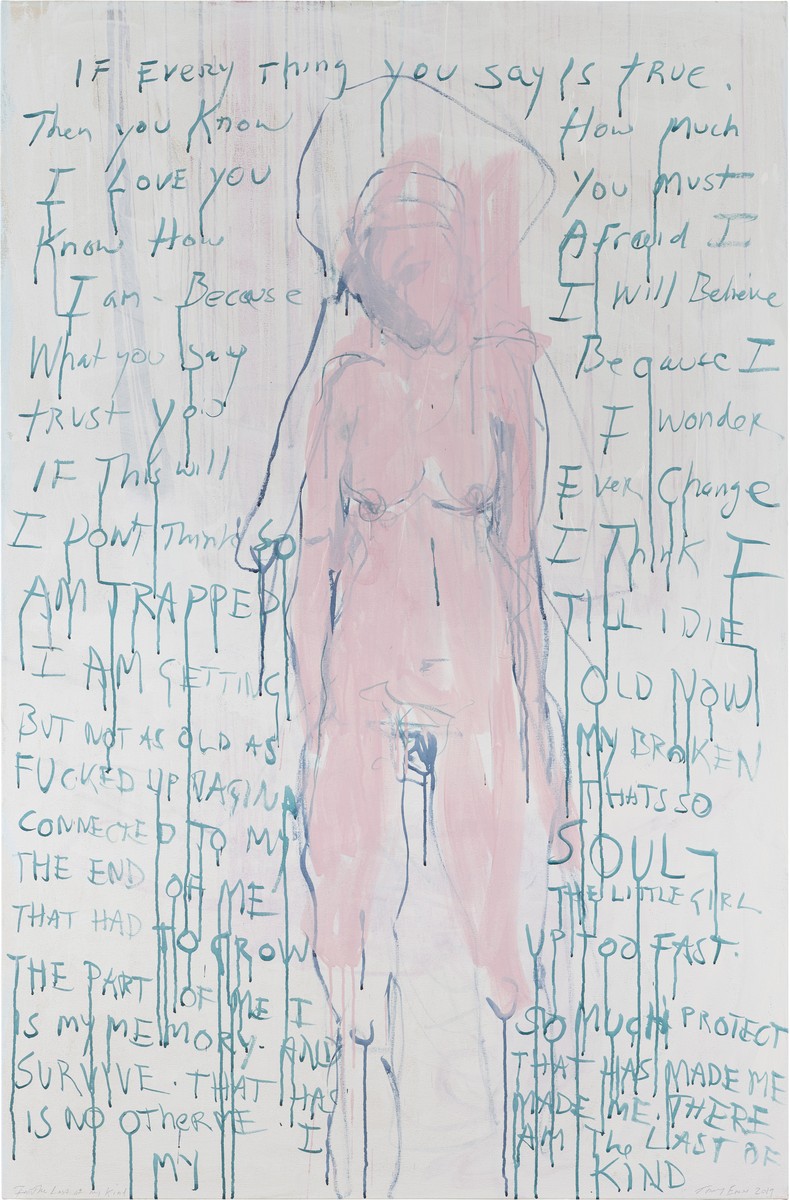
Tracey Emin, I am The Last of my Kind, 2019
Acrylic on canvas
71.77 x 47.24 x 1.38 in.
© Tracey Emin
Courtesy of Tracey Emin Studio
I write all the time and I think all the time. When I am painting, I have thoughts going through my head, so even if the painting starts off very abstract or ends up very abstract, there are still thoughts. Sometimes they're written down on the canvas or they start like the “Rome painting.” It is a really good example of how it ended up being a dialogue. There are some paintings that I have got that are just text, that are nothing else but text.
I said to myself, “People don't really like the text paintings. I wish I had kept all the text paintings. I wish I had not sold any, I wish I had kept them all. It would be really wonderful, one day, if I had all the text paintings I've ever made. I would do a show of them, I suppose, but that's not the point. I wish I had kept them all, because people don't really like them — I like them because they are really personal. They are also different. They probably looked quite boring but not if they were all together. It would read as something really interesting.
The text paintings, in some of them, the paint is really wet, so as I write it drips. And also, the ones that have a lot of text, I never know what I'm going to write. It's very thematic.
So, I don't have it written down and then I just impulsively scribble on the canvas. It is just across the painting and that's why there are all the drips, or maybe mistakes, or different things.
Harry, when he's watching me painting, he is always amazed when it fits in exactly: the last word, last sentence. Boom, stops! And it all fits in perfectly. But I had no idea what I was going to write beforehand. Some of the things are very complicated like the painting that is in the Tate, I Am The Last of My Kind (2019), that painting has really complex text, but I had no idea I was going to write it on the painting. Sometimes, I have painted works like this one in the Royal Academy at the moment, which was quite an interesting drawing, it is just not finished, and then I write the text on, and boom! It is finished, it says it all. Because otherwise, the painting could look too soft and the text brings it up to where it should be, in the mind.
AM – Exactly, you have already answered my next question. For you, writing is like painting — the text is part of the brushstroke, right?
TE – Yes, definitely.
AM – It's like a completion of the art. It is the same level for you as picking the right colour.
TE – Yes, exactly. Cy’s work is more poetic. There is a poetry. It could be one word and it reads like a poem. It is still all about the paint though.
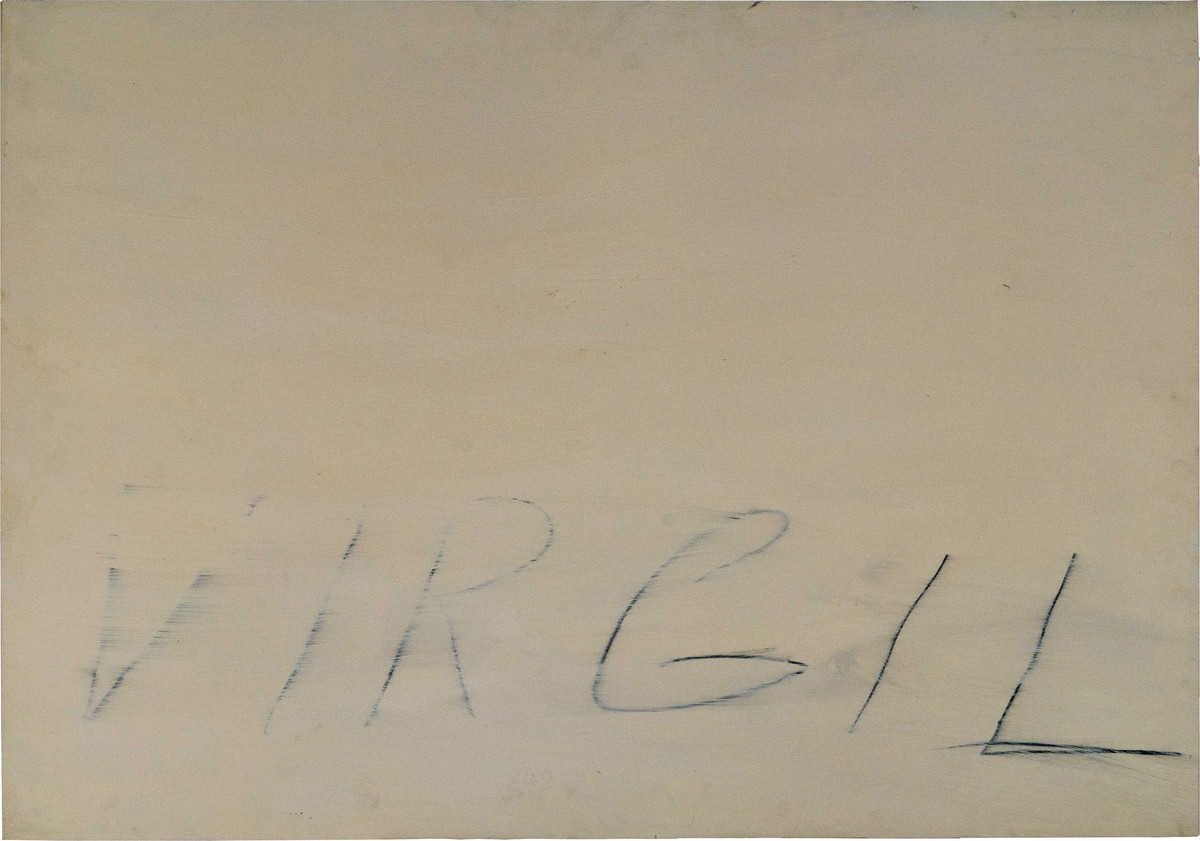
Cy Twombly, Virgil, 1973
[Rome]
Oil paint, pencil
27 3/8 x 39 1/16 in.
© Cy Twombly Foundation
AM –And you have beautiful handwriting.
TE – My handwriting… When I was young, I used to get told off about it all the time. There was a point at school where decimalisation came in, around 1971 or whatever. We were all made to write the same, sort of a typed script. When I was about seventeen or eighteen, I suddenly thought, “Why am I writing like this?” And then I just started using my own handwriting. It was such drawing, it was such freedom.
AM – You can really understand so much about personalities from handwriting.
Tracey, I've been to the Tate show multiple times, and you and Harry really did such an incredible job putting that together. It was very emotional. One of those moments, I must say, was the corridor with the polaroids — your very personal polaroids. I hear that was one of the decisions you personally made for the exhibition.
TE – Yes, I made three decisions: title of the show, the corridor, and the blue paint.
They were my ideas, the rest was Harry and the curators. That was my only input into the show, and the corridor was really important to me. I know that corridor space really well. It's brilliant — it's like a vortex that you go through. I like the polaroids and the photos, I like this journey of both of them, either side. They are so similar, but so different. I thought it expressed and explained the show, the title of the show really well.
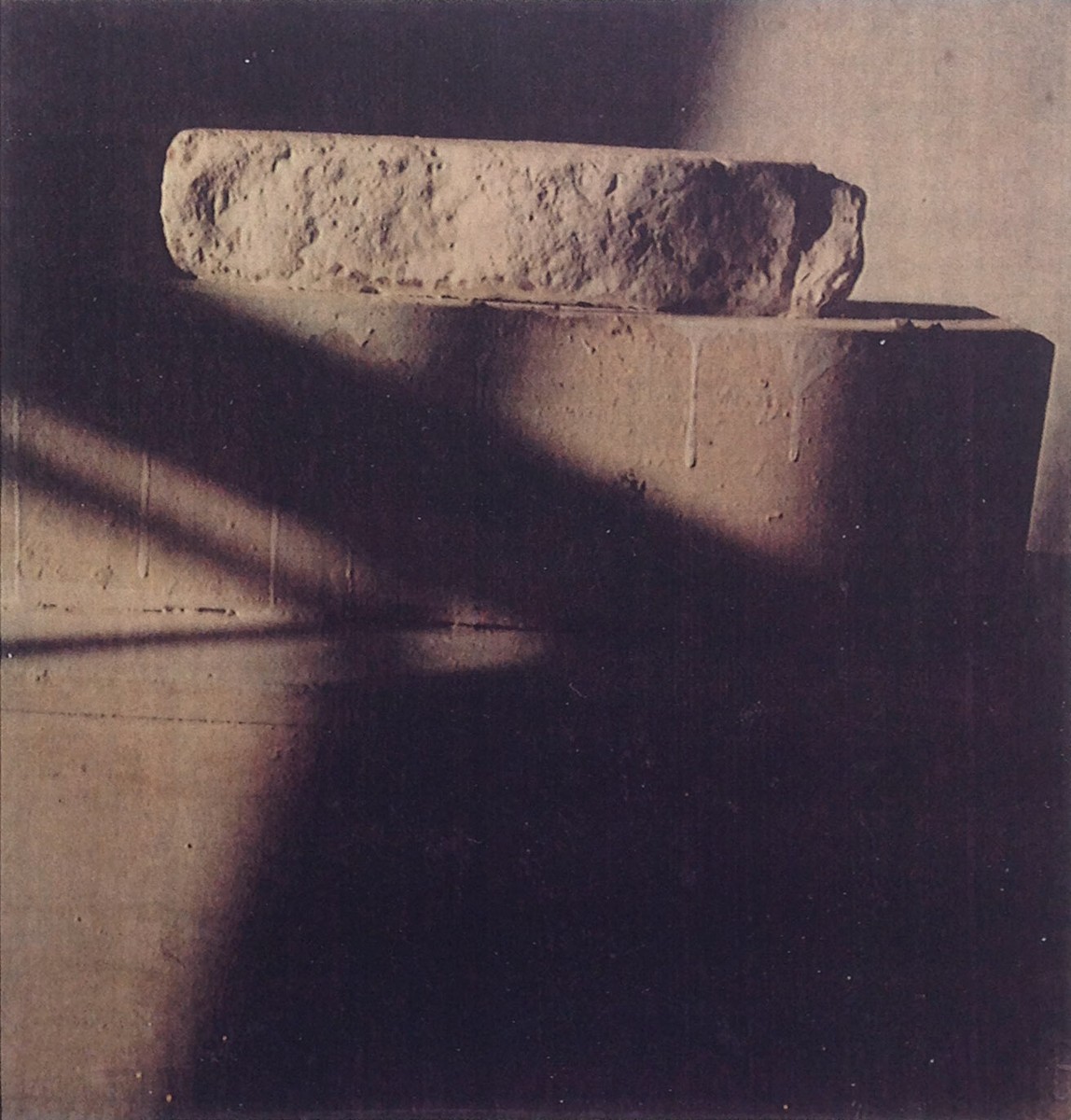
Cy Twombly, Pasargade, Gaeta, 1994
Color-dry print
24,8 x 24 cm
© Fondazione Nicola Del Roscio
AM – I totally agree. I thought the position itself, within the exhibition, was just perfect. Could you say a bit about the use of the camera? You took pictures of yourself a lot throughout your entire career. I was curious to hear whether you think about the medium of photography in the same way as making any other artwork, like a painting or a drawing, or whether you use it in a different way.
TE – I use it in a different way. When I was at Royal College of Art, my secondary subject was Sacred Geometry. The head of the department, Keith Critchlow, said, “If you can't paint or you can't draw, you have a notebook and you write in your notebook; if you have a camera take photos, just take photos of whatever you're seeing, like a diary.”
I had before only used the camera if it was like an occasion. I had never used the camera really as a diary. I used to go to photobooth machines, and have photobooth photos constantly as a diary of myself, but once he said that, I would use a disposable camera or I would think about photography differently and so when I got my Polaroid camera, that was it, I loved it. It really was like a diary because, it was immediate, it was real life, it was the light, it was everything.
I took hundreds and thousands of Polaroids. At the Tate, it is probably the first time I showed them seriously. Now, in my archive, I have thousands of photos that I have taken, all in boxes. I think one day I will do something with them, but not now. When I will be much older, it will be more relevant, more useful to see them when I'm old than to see them now, because now they are more immediate memories, even if they were twenty years ago. When I am eighty it will be far more interesting to look at them because it is like a memory. It is funny how our memories, often our memories from our childhood, are triggered by photographs that we have seen.
AM – Of ourselves, right?
TE – Of course, but then we don't have true memory, we have triggered memory. That is why I would like to see them in twenty years’ time. Right now, one of the things that I am doing slowly, not doing it properly, is trying to make a really good archive for the Foundation of my own work, that is a big project that I am working on now.
I like to be ahead of myself, so I don't want to suddenly be dying and say, “Oh my God, my archive!” So, I want to have it all looking really good and nice, and I want to enjoy my archive.
That is why I have got the Foundation: most people have a Foundation when they are about to die, they do it for tax reasons. I have done it because I thought I was going to die and I haven't died. Now, I have got this Foundation with the school and everything. I can really enjoy it. It is something nice for me too, I can enjoy this moment.
It is the same with the archive. I don't want to have an archive for when I am dead, I want to archive for when I am alive. Also, it means that if people are writing about me or doing something, they can come and research it, which is much nicer than doing online research.
AM – So, in the future, I feel that you have this incredible project and so many other things. You brighten up when you talk about these things, Tracey.
TE – I see it as work. I see it as making art. I see it as part of something. I like that my great grandfather came from Nubia, and he always said that the ancient Egyptians got ready for death nearly all their lives. Building for death. Getting ready for death, for the big journey. And now, after this second life of mine, my third life will be getting ready for the great journey.
Everything I will be doing is getting ready to leave everything behind.
That’s a really nice project: leaving everything neat, leaving everything tidy, leaving everything correct.
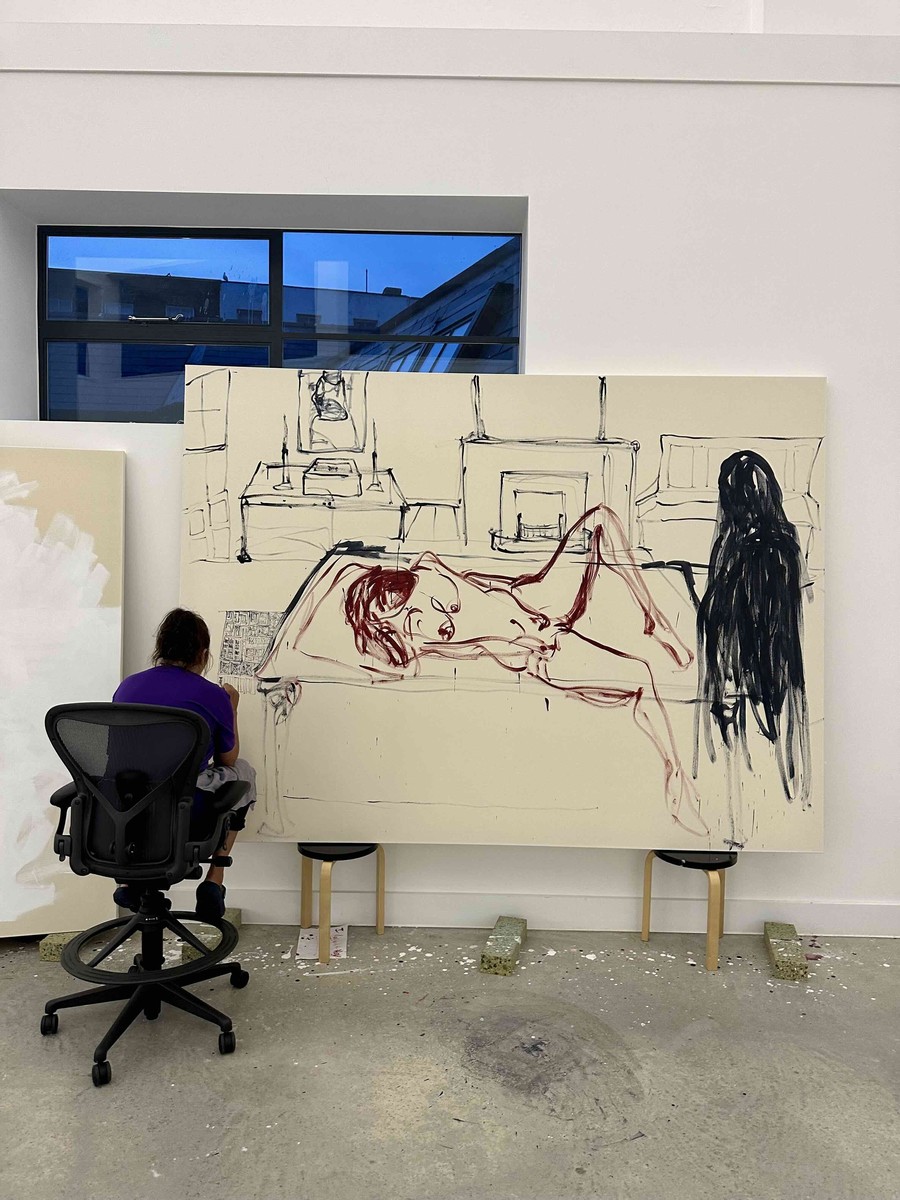
Tracey sitting, painting the carpet on I watched Myself die and come alive again, 2023
Courtesy of Harry Weller
Adele Minardi is an art historian with over a decade of international experience managing museum-quality exhibitions and liaising with leading contemporary artists at a major commercial contemporary art gallery.
Her work has included collaborations with public and private collections, prominent art institutions, and foundations, among them the Cy Twombly Foundation.
Cy Twombly Foundation is deeply grateful to Dame Tracey Emin for her generous and sharing spirit, offering inspiring reflections on her work and personal memories of Cy Twombly.
Our greatest thanks are extended to Harry Weller, Creative Director of Tracey Emin Studio, Alison Kelsey, Executive Assistant of the artist, and Adele Minardi for their invaluable collaboration in making this episode possible.
Our appreciation is due to Lorcan O'Neill and Laura Chiari for their support.